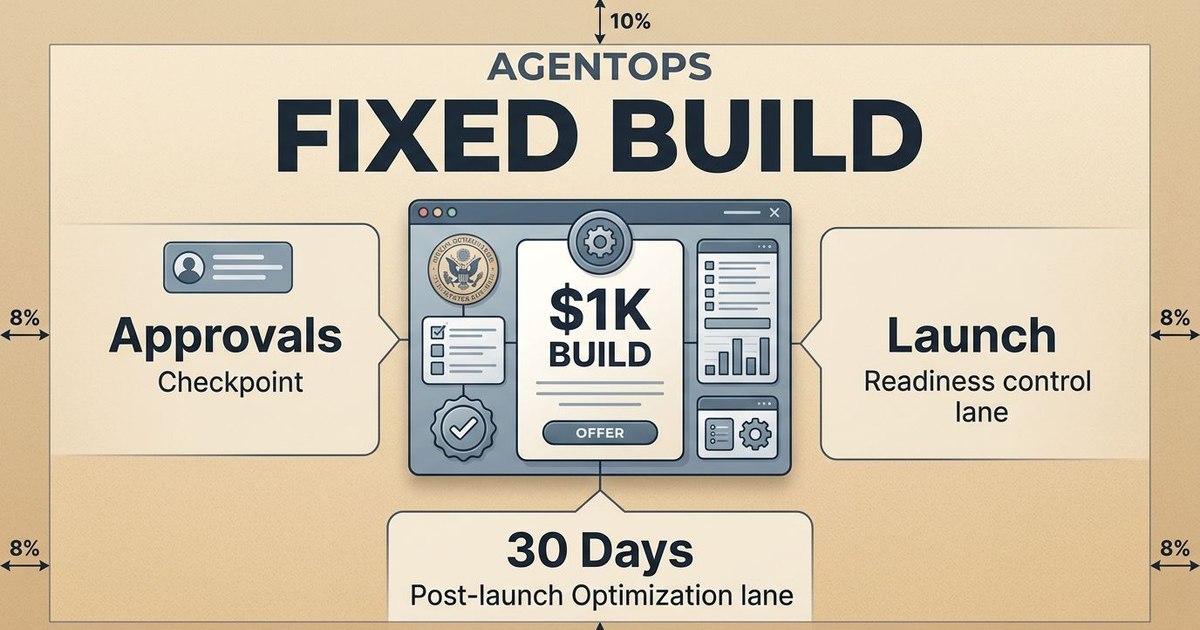
I launched the AgentOps workflow automation build because I got tired of seeing the same pattern play out in expensive slow motion.
A team would collect a dozen AI workflow ideas, get excited about the biggest one, skip past approvals and ownership, then ask for implementation as if the hard part were the prompt. A month later they had a brittle prototype, no one knew who was allowed to approve changes, and the actual business metric still had not moved.
That is why I packaged this offer as one fixed build instead of an open-ended consulting engagement.
Why I sell one workflow instead of a giant automation roadmap
Most teams do not need more ideas. They need one workflow that can survive contact with production.
I have found that the first useful boundary is small and specific:
- one measurable business outcome
- one accountable operator
- one approval model
- one workflow with a clear start and stop
That is the boundary I use in every governed automation workflow.
It is deliberately narrow because narrow scopes are easier to launch, easier to observe, and much easier to improve. If I let the first build become "replace half our operations with AI," the project usually turns into coordination theater.
What the fixed $1,000 build is actually buying
The offer is not a recommendation deck.
It is one scoped implementation path from ambiguity to a live workflow with controls.
What I am really selling is decision quality before build quality. The implementation matters, but the more valuable move is forcing the right operating questions before the automation becomes real:
- What exactly should this workflow optimize?
- Who owns it after launch?
- Which actions require approval?
- What should happen when inputs are incomplete or confidence drops?
- What counts as success after week one?
If the answer to those questions is still fuzzy, I would rather surface that early than hide it behind polished demos.
For teams that are still at the template-and-notes stage, I point them to the vault workflows guide before anyone starts building.
Who this build is for
This offer works best when the buyer already has some operational seriousness.
The strongest fit looks like this:
- there is one business metric that matters right now
- one person can make decisions during implementation
- the workflow touches tools and data the team actually controls
- approvals and exceptions matter enough that "just automate it" is not good enough
The weakest fit is someone who mostly wants inspiration.
I do not mean that disrespectfully. Inspiration is useful. It is just a different product. If the real need is "help me brainstorm ten AI ideas," then a fixed implementation build is the wrong container. The right next step is usually self-serve work inside SystemSculpt for Obsidian and the docs, not a done-with-you launch.
The operating model I use inside the engagement
I keep the process simple on purpose.
First, I narrow the workflow boundary and make sure the owner, metric, and approval rules are explicit. Then I score the candidate against business upside, implementation drag, and governance risk. Then I build the workflow that still looks smart after those constraints are on the table.
That means I am not just asking whether a workflow is exciting. I am asking whether it is durable.
The control layer matters more than people expect. Before I am comfortable launching, I want:
- trigger conditions that are narrow enough to reason about
- approval gates that match the blast radius of the action
- logging that someone will actually review
- rollback behavior that is real, not theoretical
That is also why I like using a repeatable review loop after launch. A workflow that looks good on the day it ships can still drift fast if nobody is checking failure modes, operator burden, or low-confidence edge cases. The vault workflows guide is useful here because it forces the workflow to stay legible.
What usually goes wrong before people call me
The same mistakes show up again and again.
The first one is scope inflation. Teams try to automate a whole department when they should have chosen one repetitive path with a named owner.
The second is KPI vagueness. "Improve efficiency" is not a launch target. It is a wish. I want something tighter, like cycle time, conversion rate, response latency, or approval backlog.
The third is governance afterthoughts. People assume approvals can be added later, but by then the workflow logic is already shaped around the wrong trust model.
The fourth is no post-launch rhythm. A workflow without review turns into a local hero story for one week and then becomes invisible infrastructure that nobody maintains until it breaks.
That is why this offer includes 30 days of optimization, maintenance, and upgrades. The follow-through matters. I do not think a workflow is "done" just because it ran once.
What I would do before booking
If you are considering this build, I would prepare six things:
- Name the one metric you want to move first.
- Pick the one operator who can approve tradeoffs during implementation.
- Write down the systems the workflow will touch.
- List the failure modes that would be unacceptable.
- Be honest about what still needs human review.
- Decide whether you want one live workflow or a strategy project.
If you can do that prep, the build moves faster and the end result is better.
If you cannot yet, that is fine too. It usually means the right move is not to buy implementation immediately. It means tightening the workflow definition first.
My view on the next step
If you already have an owner, a budget, and one clear workflow target, write down the acceptance path before implementation starts.
If you are earlier than that, I would not force it. Start with SystemSculpt for Obsidian, use the workflow guidance, make the approval model explicit, and get one internal process legible enough to score.
I care less about making automation look ambitious than I do about making it survive the first real month of use.
If you want to apply this approach inside your vault, start with the vault workflows guide.