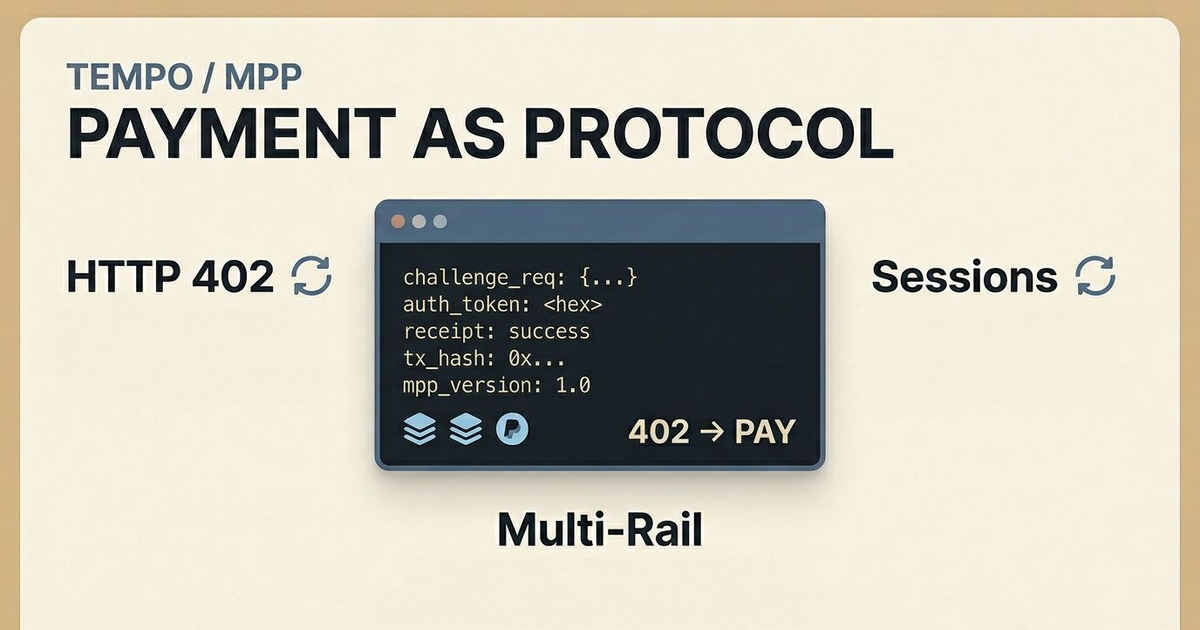
Yesterday, Tempo posted one of the bigger claims I have seen in the agent-payments wave: agent payments will soon overtake human payments on the internet.
Tempo's machine-payments claim
The companion launch post was better.
Tempo's companion mainnet announcement
I do not know if I buy the timeline on the first sentence.
I do think the thing underneath it is real.
Tempo did not just post a vague "agents will buy stuff" thread. It launched Tempo Mainnet, published Tempo docs for machine payments, shipped an open MPP specification repo on GitHub, and showed Stripe support for MPP on the same day.
That is the part worth paying attention to.

The loud prediction got the headline. The more interesting signal is that the protocol surface is already legible.
The interesting part is not "AI agents will buy things"
The interesting part is that Tempo is trying to make payment look like a normal request flow again.
Tempo's own docs describe MPP as a way to add inline payments to any HTTP endpoint. The flow is boring in exactly the right way: the client requests a resource, the server answers with a payment challenge, the client pays, retries, and gets the resource plus a receipt. The Tempo docs, Stripe's MPP docs, and the MPP spec repo all point at the same basic shape.
GET /resource
→ 402 Payment Required
WWW-Authenticate: Payment ...

GET /resource
Authorization: Payment <credential>
→ 200 OK
Payment-Receipt: ...
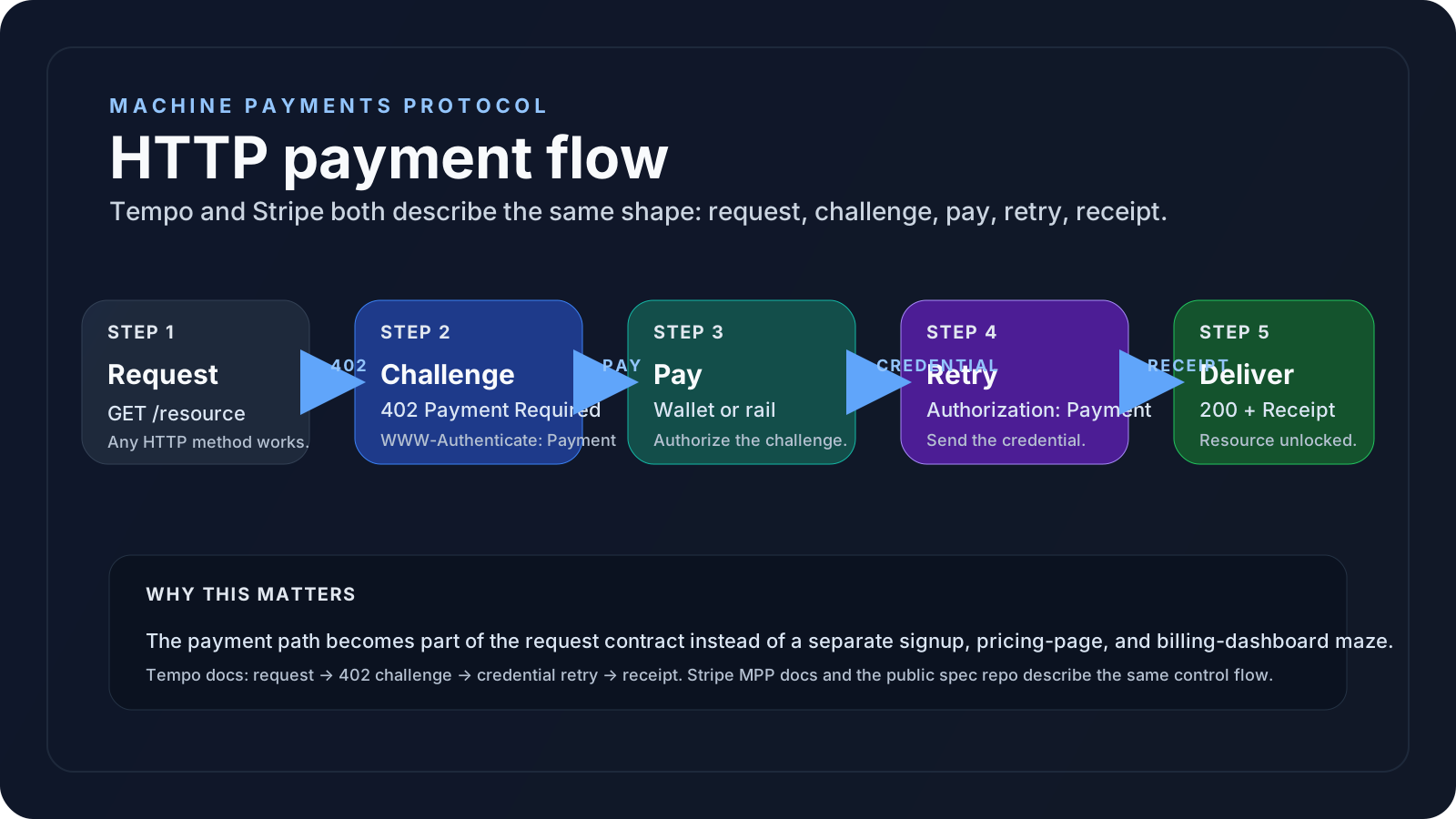
That is the whole reason this feels more important than a generic launch thread. It is trying to turn billing into a protocol instead of another custom dashboard maze.
This matters because most agent commerce demos still hide the ugly part.
The hard part is not getting an agent to click a buy button once. The hard part is making repeated, low-value, machine-initiated payments feel explicit, inspectable, and cheap enough to use inside real workflows.
Tempo is clearly optimizing for that exact use case. Its machine-payments docs call out three builder targets directly:
- paid APIs
- monetized MCP tools
- digital content without subscription gates
That is a much more concrete story than "the agent economy" as a slogan.
The docs also split payment behavior into two clear intents:
| Intent | Best for | Latency | Cost shape |
|---|---|---|---|
| Charge | Single API calls, content access, one-off purchases | ~500ms | Per request |
| Session | LLM APIs, metered services, usage-based billing | Near-zero | Amortized across many requests |
That distinction from the Tempo docs is one of the strongest signs that they are thinking about real workloads, not just a demo transaction.
This is not just launch copy
A lot of companies can write a good launch post.
Fewer companies launch with this many visible implementation surfaces at once:
- an official mainnet announcement from Tempo
- live developer docs
- a public specification repo
- Stripe documentation for MPP
- a Stripe blog post naming real early use cases
The spec repo is especially important.
Its README says MPP is "the open protocol for machine-to-machine payments," shows the 402 Payment Required flow explicitly, and says the specification is currently maintained by Tempo Labs and Stripe. It also frames the design as extensible, network-agnostic, multi-rail, and durable by design.
That is a better signal than hype copy.
It means the argument is not just "trust us, this will be big."
It is "here is the control flow, here are the headers, here is the repo, here is the docs surface, and here is how other payment methods can plug in."
That is the kind of boring scaffolding I want to see when a company makes a big category claim.
Stripe's blog adds another useful piece of evidence. It says Stripe businesses can accept payments over MPP with their existing Stripe infrastructure, and it names concrete examples already using it: Browserbase for headless browser sessions, PostalForm for physical mail, Prospect Butcher Co. for sandwich ordering, and even Stripe Climate contributions.
That does not prove mass adoption.
It does prove this is past the stage of a vague concept deck.
The most interesting part might be Stripe's protocol stack
The single most interesting detail I found was not inside the Tempo post itself.
It was in Stripe's broader docs and launch language.
Stripe's machine payments docs now point to both MPP and x402. The same Stripe blog post about MPP also says Stripe is building agentic financial infrastructure through the Agentic Commerce Protocol, MCP integrations, and support for both MPP and x402. Coinbase's own x402 launch writeup also leans on the dormant HTTP 402 Payment Required code as the core primitive.
That creates a much more interesting picture than "Tempo launched a blockchain."
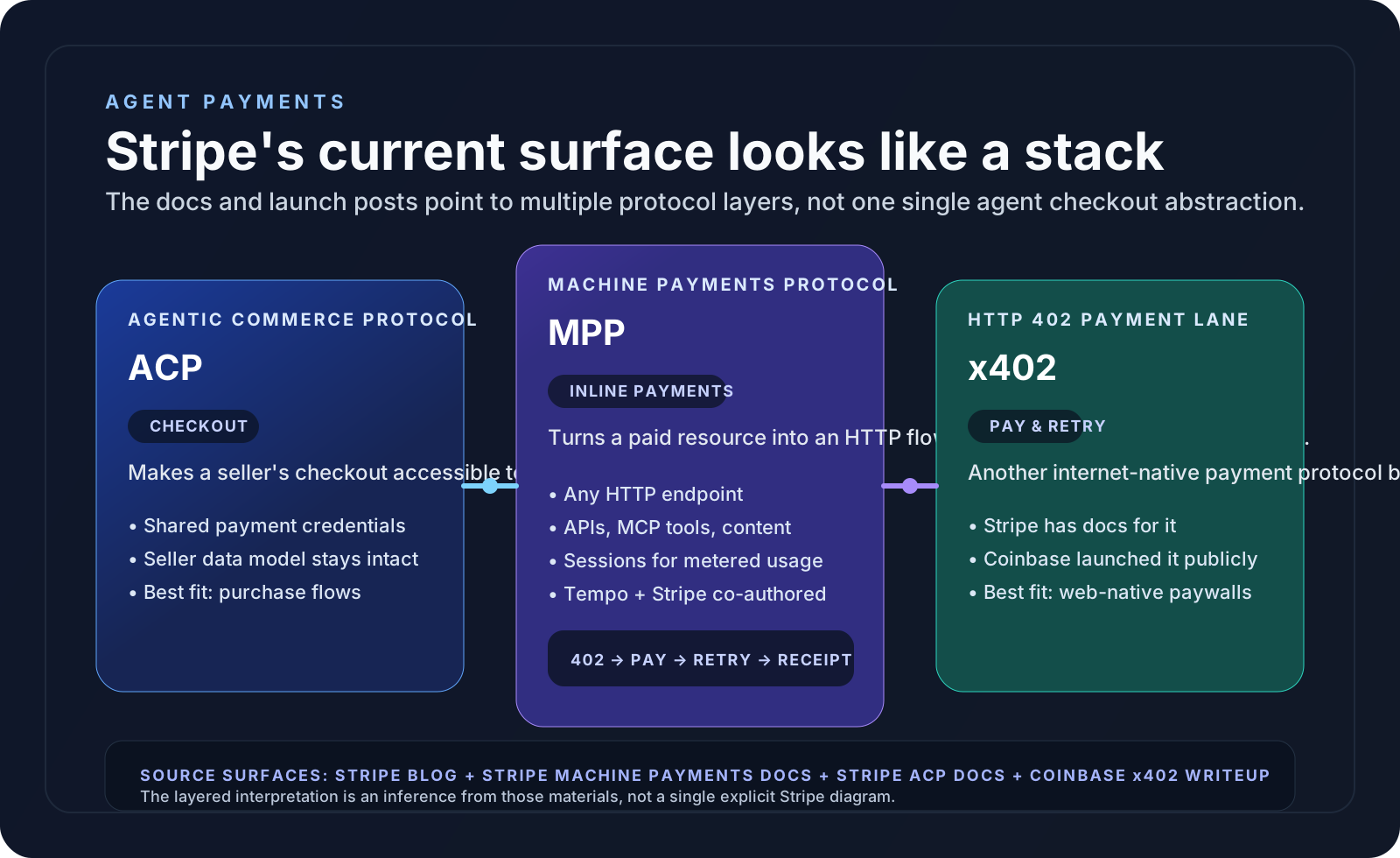
My read is that Stripe is not betting on one magical agent checkout flow. It is covering multiple layers of the problem at once.
Here is my inference, based on the retrieved docs rather than an explicit Stripe statement:
- ACP looks like the seller and checkout layer.
- MPP looks like the inline machine-to-machine payment layer.
- x402 looks like another HTTP-native payment lane that Stripe is willing to support in parallel.
That matters.
It suggests serious players do not think agent payments will collapse into one standard immediately. They think this will be a stack: checkout protocols, resource-payment protocols, wallet or credential handoff, and settlement rails underneath.
That feels a lot more realistic.
Why I care more about this than the chain itself
I care less about whether Tempo wins as a chain brand.
I care more that billing is starting to become explicit again.
The current web has made small, repeated payments weirdly awkward. If you want to charge for an API, a tool call, or a piece of content, you usually end up with some miserable combination of:
- account creation
- prepaid credits
- API keys
- subscription tiers
- webhook glue
- billing pages designed for humans, not workflows
That is fine when the user is a person making a deliberate purchase once a month.
It is much worse when the user is a workflow that needs to spend nine cents here, forty cents there, and keep moving.
Tempo's docs are blunt about the opportunity: paid APIs, MCP tools, and gated content can all become machine-payable endpoints. Its mainnet launch post also makes a second point I think is easy to miss: Tempo is not only positioning this for agents. It is also positioning the same infrastructure for global payouts, cross-border remittances, embedded finance, and tokenized deposits, with partners it names including Anthropic, DoorDash, Mastercard, Nubank, OpenAI, Ramp, Revolut, Shopify, Standard Chartered, and Visa.
That is why I think the launch is more interesting than it first looks.
It is trying to bridge two worlds at once:
- agent-native per-request and per-session commerce
- established payment workloads that need better settlement rails
If that works, the upside is not just "agents can buy stuff."
The upside is that the boundary between calling a service and paying for a service gets thinner.
What I still would not assume yet
I would not jump from this launch to "machine payments are solved."
A cleaner payment protocol does not erase the rest of the hard problems:
- delegated authority and spend limits
- identity and trust between services
- abuse, fraud, and chargeback-like disputes
- tax and reporting requirements
- refunds and reversals
- when a human must still stay in the loop
Tempo's docs help because they make the payment path legible.
They do not magically make every commercial edge case disappear.
I also would not assume MPP becomes the only standard. The fact that Stripe is supporting both MPP and x402, while also pushing ACP for checkout contexts, tells me the protocol surface is still being worked out in public.
That is not a weakness.
That is what an early category usually looks like.
My next-step checklist if I were evaluating this for a real product today
I would test three things before I built any serious business flow on top of it:
- Can I get one paid endpoint live quickly enough that the payment path stays simpler than my current billing glue?
- Do session-based flows actually make metered usage feel smooth under real load, not just in a launch demo?
- Can I express spend limits, auditability, refunds, and approval boundaries clearly enough for a real operator to trust?
If the answer to those three is no, then the protocol is still more interesting as research than as production infrastructure.
If the answer starts becoming yes, the category changes fast.
My read on it
I think Tempo's mainnet launch matters less because it is a new chain and more because it makes a serious attempt to turn payment into a machine-usable request contract.
That is the important part:
- explicit HTTP control flow
- open spec repo
- multi-rail design
- Stripe integration surface
- direct support for APIs, MCP tools, and metered services
That combination is much more interesting than generic agent-commerce hype.
If this category works, the future of buying compute, data, content, and tool access will feel less like negotiating a SaaS plan and more like calling an endpoint with clear payment semantics attached.
That is a big shift.
And even if Tempo itself ends up being only one piece of the market, this launch is strong evidence that serious companies are now trying to make machine payments boring in the right way.
I would bet on that trend long before I would bet on any one prediction about agent payments overtaking human payments on a calendar.
If you are building agent-heavy workflows and want the control surfaces to stay explicit instead of dissolving into hidden billing glue, the same design principle appears in SystemSculpt's vault workflows.