If you search for the best Obsidian AI plugins in 2026, you mostly find the same weak roundup over and over.
A grid of logos. A feature checklist. A paragraph that treats "has chat" as if that settles the question.
That is not how I choose plugins for a real vault.
I originally tested the products in this comparison before publishing it. For this July 22, 2026 refresh, I rechecked each product's current official site, documentation, or public launch material and narrowed claims that had drifted.
I care about four things instead: can it retrieve the right context, can it act without turning my notes into collateral damage, can it support repeatable workflows instead of one-off prompts, and can a normal person install it without building a side career in plugin babysitting.
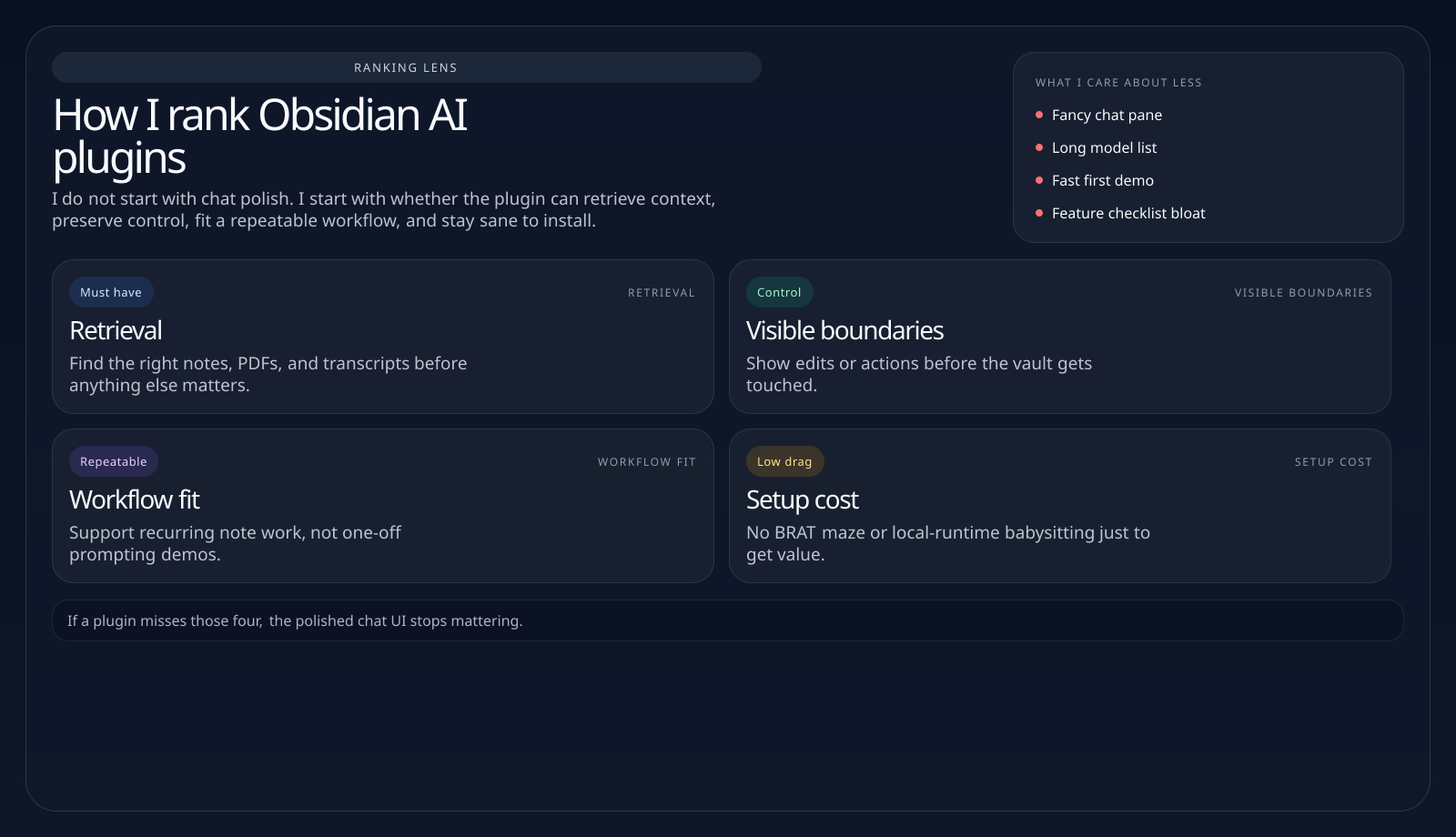
That lens changes the ranking fast.
Most Obsidian AI plugin lists optimize for demos, not actual vault work
A logo grid and a feature checklist tell you almost nothing about what a plugin does to a vault you have spent years building. "Has chat" is table stakes in 2026. The differences that matter only show up once a plugin is allowed to read, search, and edit notes you actually care about.
You will also notice the usual headliners are not ranked here. Copilot for Obsidian is a capable chat surface, Smart Connections made vault-aware retrieval popular, and Smart Composer handles inline writing well. I keep a separate, regularly updated head-to-head on exactly those matchups: SystemSculpt vs other Obsidian AI plugins. This post answers a narrower question.
Of the plugins I could verify hands-on in 2026, which ones would I trust inside a vault I rely on every day?
Most comparison posts still review these tools like they are chatbot skins. The four tests at the top of this post, retrieval, editing boundary, workflow surface, and deployment friction, are what actually separate them.
My ranking starts with retrieval and control, not prompt polish
Here is the shortest version of my current ranking.
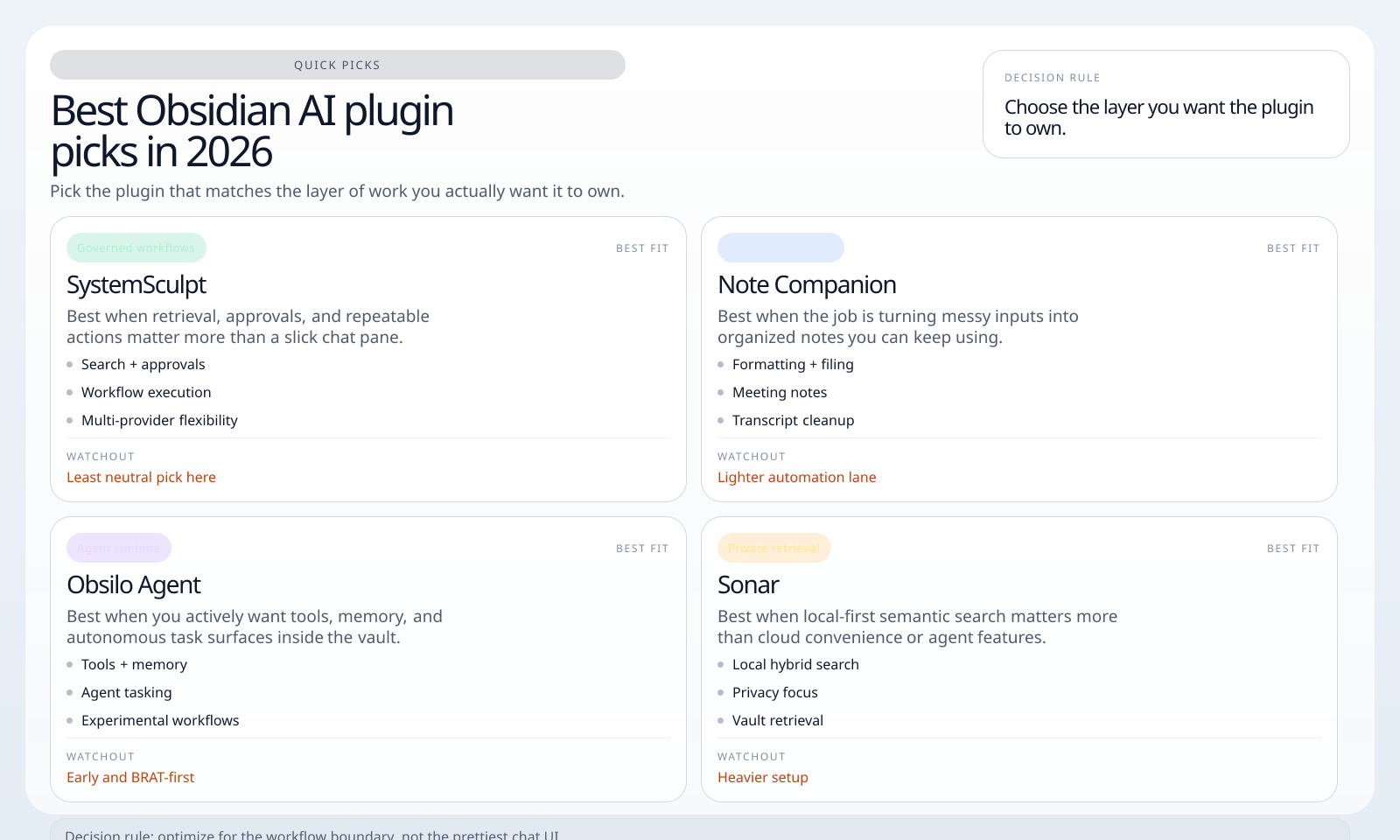
If you want the quickest answer:
- use SystemSculpt if you care about approvals, governed actions, semantic search, and managed AI inside Obsidian
- use Note Companion if your main pain is organizing notes, transcripts, links, and inbox material
- watch Obsilo Agent if you want a more autonomous tool surface and are comfortable with earlier-stage rough edges
- use Sonar if local-first retrieval matters more than polished cloud convenience
Here is the same comparison as a scannable table, scored on the four tests above:
| Plugin | Best for | Retrieval | Control & approvals | Workflow surface | Setup friction |
|---|---|---|---|---|---|
| SystemSculpt | Governed vault workflows | First-class hybrid semantic search | Approvals stay visible before meaningful file changes | Repeatable multi-step vault workflows | Friendly for a normal Obsidian user |
| Note Companion | Turning chaos into organized notes | Vault context and note organization | Command-driven note processing | Capture, formatting, transcription, and note cleanup | Cloud subscription or self-hosted backend |
| Obsilo Agent | Treating Obsidian as an agent runtime | Hybrid semantic search with 3-tier memory | Higher autonomy, earlier-stage safeguards | 55+ tools, MCP connectors, multi-agent tasks | Higher, earlier-stage |
| Sonar | Private, local-first retrieval | Local semantic search, hybrid retrieval, reranking | Local and private by design | Retrieval and private RAG over the vault | Local-first setup |
That list is opinionated on purpose.
A lot of the live discourse around this category is finally catching up to the same point: the interesting part is no longer just the model. It is the knowledge base and workflow layer around it.
One disclosure upfront: one of these plugins is mine. That is why I would rather make the scoring lens explicit than pretend this is neutral.
SystemSculpt is the one I would choose for governed vault workflows
I built it, so I know exactly what problem I was trying to solve.
The core problem was never "I wish Obsidian had another chat window."
It was this: once an AI tool can read across your vault, generate files, edit notes, and run workflows, you need a boundary between suggestion and action. Otherwise you just built a faster way to make a mess.
That is why SystemSculpt centers approvals, workflow execution, and retrieval quality instead of stopping at chat. The current plugin docs emphasize semantic search, vault workflows, and managed AI for every workflow, with no provider accounts or API keys to manage.
Two things matter more to me than the provider list:
- Retrieval is built in as a first-class surface. If an Obsidian AI tool cannot find the right context, the rest of the UX is theater.
- Approvals stay visible. I want a workflow to pause where review matters, not silently rewrite half a vault because the model felt confident.
That is the biggest dividing line in this category now. Plenty of tools can answer. Fewer are designed to collaborate.
If your goal is "help me search, reason over notes, and move through repeatable vault workflows without losing control," this is still the category I think SystemSculpt serves best.
Note Companion looks strongest when the job is turning chaos into organized notes
The most credible alternative I found for a different kind of user is Note Companion.
Its current official site and Obsidian community listing position it less like an autonomous agent and more like a structured note operations layer: audio and YouTube transcription, note organization, vault chat, and explicit commands for processing or formatting notes. It offers a hosted subscription and a self-hosted backend path, which makes the setup tradeoff more nuanced than a cloud-only label.
That is a real use case.
A lot of Obsidian users do not need governed agent workflows. They need help moving from:
- inbox clutter
- meeting notes
- transcript dumps
- saved links
- half-processed ideas
…into cleaner notes they can actually keep using.
That is where Note Companion makes more sense than an "agent" pitch. It feels more like an AI note operator than a mini autonomous operating system.
I would rank it higher for organization-heavy knowledge work than for multi-step automation. That is not a knock. It is a clearer product shape.
Obsilo Agent is the most interesting bet if you want Obsidian to feel like an agent runtime
The most ambitious current entrant I found is Obsilo Agent.
Its official launch material and current docs pitch a plugin with 55+ tools, hybrid semantic search, 3-tier memory, MCP connectors, skills, workflows, and multi-agent tasking inside the vault. That is a much more agent-native pitch than the standard "ask AI about your notes" framing.
That makes it interesting immediately.
It also creates the exact concern I always come back to: more autonomy raises the price of weak boundaries.
If you are the kind of user who actively wants:
- tool calling
- workflows and connectors
- persistent memory
- long-running vault tasks
then Obsilo Agent is one of the most important projects to watch right now.
But I would still treat it as an earlier-stage pick than something I would hand to a normal Obsidian user without supervision. Community-store maturity, docs depth, and real workflow safeguards matter more as the action surface expands.
That does not mean "avoid it." It means know what kind of product you are adopting.
Sonar is the strongest answer if your real problem is private retrieval
The local-first lane matters enough that I would not ignore it.
Sonar's public launch post is much more retrieval-centric: local semantic search, hybrid retrieval, reranking, and private RAG over your vault. If you care most about keeping your knowledge base local and searchable, that is a different buying decision than choosing an all-purpose AI assistant.
This is why I think a lot of "best Obsidian AI plugin" posts are broken at the category level.
They lump together tools that are solving different jobs:
- vault search
- note formatting
- writing assistance
- autonomous actions
- workflow governance
That is not one market. It is a stack.
If your main issue is "my vault is large and I need better retrieval without shipping everything to a remote black box," Sonar deserves real attention even if it is not trying to be the prettiest all-in-one assistant.
The wrong way to choose is by model count or chat polish
This is the part I wish more reviewers would say plainly.
Most AI plugin comparisons overweight:
- number of supported models
- whether the chat panel feels slick
- how fast the first response appears
- whether it can summarize a note on command
Those things matter a little.
They are not what decides whether the tool still feels good after three weeks of real use.
What matters more is whether the plugin helps you run a durable loop.
retrieve context -> draft or suggest -> review -> apply -> keep the vault coherent
If that loop is weak, the plugin becomes novelty software.
If that loop is strong, the plugin becomes infrastructure.
That is also why older standalone roundups already feel dated. Obsidian's plugin ecosystem has moved past simple prompt helpers. Current tools are splitting into clearer lanes: retrieval engines, workflow operators, and autonomous agent surfaces. The 2026 question is no longer "does this plugin use AI?" It is "what layer of work is it actually owning?"
My actual recommendation depends on what kind of Obsidian user you are
If you want the practical recommendation instead of the analysis, here it is. The right pick changes a lot depending on whether your bottleneck is retrieval, organization, or higher-autonomy task execution.
Pick SystemSculpt if:
- you want approvals before meaningful file changes
- you care about search plus workflows, not just chat
- you want managed AI for every workflow, with no provider keys to manage
- you think trust and review matter more than raw autonomy
Pick Note Companion if:
- your problem is information cleanup more than agent execution
- you want help turning raw inputs into better notes
- you care about organization and processing more than autonomous behavior
Pick Obsilo Agent if:
- you want Obsidian to act more like an agent platform
- you are comfortable adopting something more aggressive and earlier-stage
- you actively want tools, memory, MCP, and task execution inside the vault
Pick Sonar if:
- retrieval is the core job
- local-first matters a lot to you
- you are willing to trade some convenience for privacy and control
That is the comparison I wish I had seen more often in search results.
Not "here are ten plugins with AI in the description."
Here is what each one is actually for.
The best Obsidian AI plugin is the one that matches your workflow boundary
My own bias is obvious: I think the future of AI in Obsidian is not a smarter chat bubble. It is a better operating loop around the vault.
That means the best plugin is not the one with the flashiest first-run demo.
It is the one whose boundary matches your actual work.
If you want governed workflows, approvals, and retrieval that can support repeatable knowledge work, I would use SystemSculpt for Obsidian. If you want to see the same trust model applied to writing, the safer workflow is in Obsidian AI Assistant for Writing.
If you want a lighter first step before you commit to a bigger system, the SystemSculpt guides and vault workflows docs are better places to start than another generic roundup.